


DiG gives flow-matching VLA policies an internal reliability signal, helping them down-weight unreliable training pairs and refine uncertain action chunks before execution.
Framework
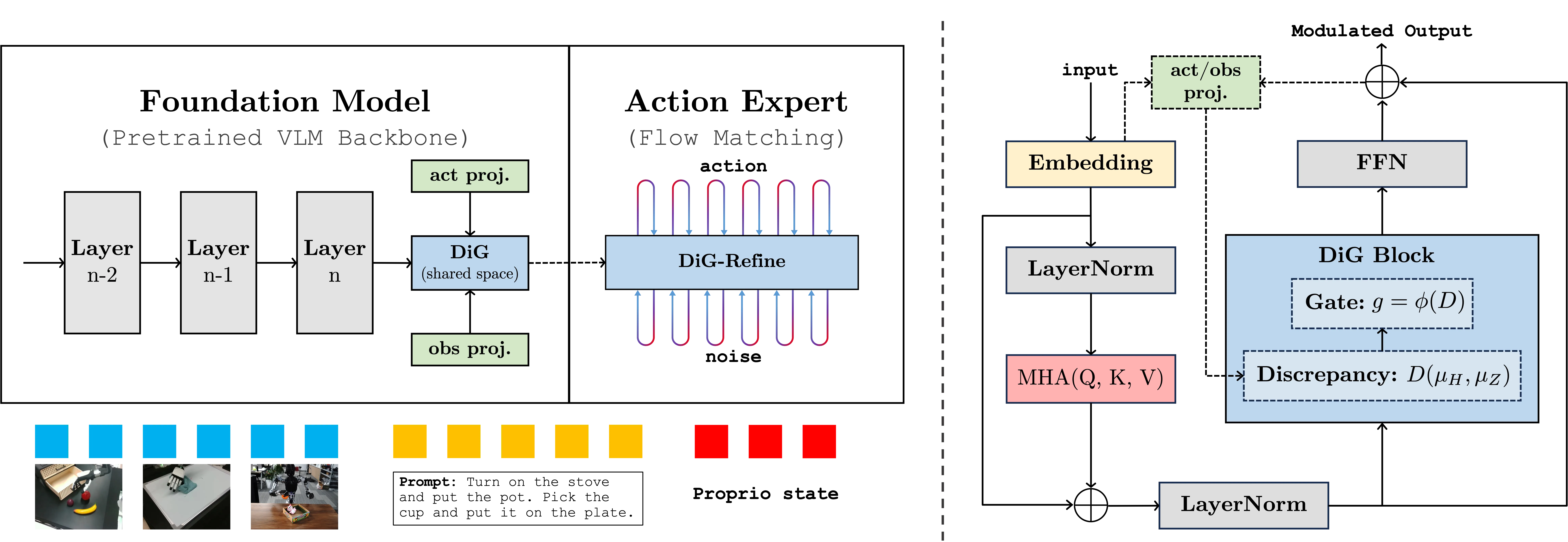
DiG is a plug-and-play module for flow-matching-based VLAs. It compares the backbone features of the current observation with a compact action-side representation produced by the action expert's own projection. The resulting sliced Wasserstein transport cost is mapped into a gate, which modulates both feature refinement and the flow-matching loss. At deployment time, the same gate supports DiG-Refine, an iterative action-chunk refinement procedure before execution. DiG integrates naturally into recent VLA architectures, including π0.5, GR00T-N1, and Being-H.
Key Concept
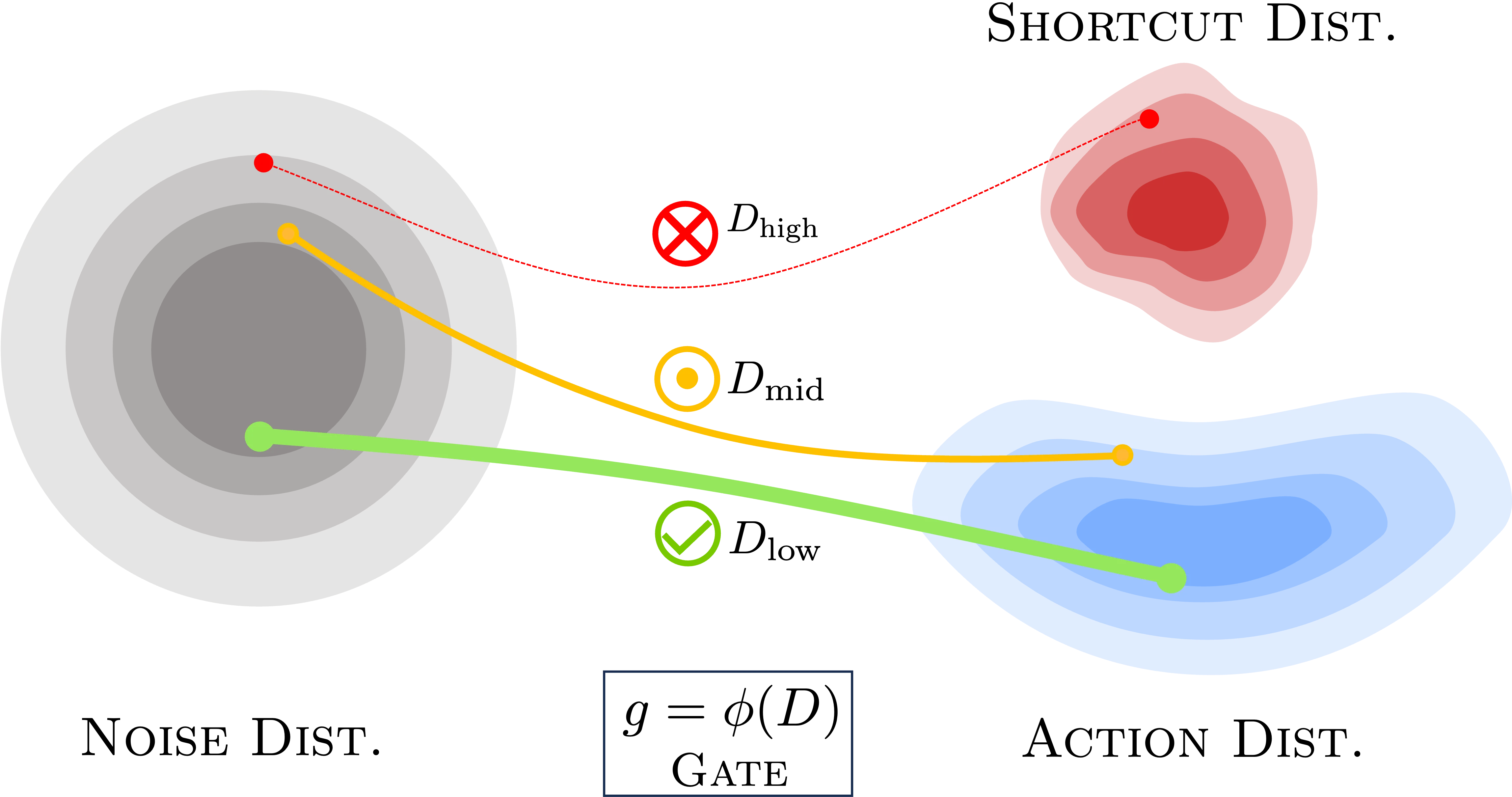
The key concept of DiG is to use transport geometry as a reliability test. When the observation representation remains close to the region that the action expert can decode reliably, the transport discrepancy stays low. Under visual shift, spurious cues, or accumulated rollout drift, this discrepancy rises. DiG turns that signal into a gate: reliable samples receive stronger learning signal and direct execution, while unreliable chunks can be refined before they are sent to the robot.
Features
Robust Control
The benefits of DiG are particularly pronounced for high-DoF robots. On a complex platform that simultaneously controls the head, body, and dexterous hands, DiG produces more stable executions than baseline flow-matching VLAs. Beyond improving success metrics, it remains robust across diverse affordances, unseen objects, and variations in background and lighting.
Long Horizon
DiG excels on long-horizon tasks because it can react to representation drift as errors accumulate across multiple steps. The gate provides a per-step check on whether the current observation and predicted chunk remain coherent in the shared feature space. Under shifted backgrounds, the advantage of DiG over standard VLA baselines on long-horizon tasks becomes even more pronounced.
Action Planning
DiG helps action planning by refining unreliable chunks before execution. Even under severe goal occlusion, it can still complete the task. For example, in the “wipe-whiteboard” task, many baselines lose track of the goal once it is occluded and fall into endlessly executing “wipe” actions, whereas DiG enables more coherent action planning and avoids such degenerate behavior.
Spatial Precision
DiG enhances spatial precision by checking whether the action expert is operating in a representation region it can decode reliably. When spatial cues become ambiguous or shifted, the transport discrepancy increases and the gate steers the model toward more reliable feature refinement, so the generated actions more faithfully reflect the visual context.
Citation
@inproceedings{zhang2026transport,
  title={Transport Discrepancy as a Reliability Signal for Vision-Language-Action Models},
  author={Wanpeng Zhang and Ye Wang and Hao Luo and Haoqi Yuan and Yicheng Feng and Chaoyi Xu and Sipeng Zheng and Qin Jin and Zongqing Lu},
  booktitle={European Conference on Computer Vision (ECCV)},
  year={2026}
}