
Overview
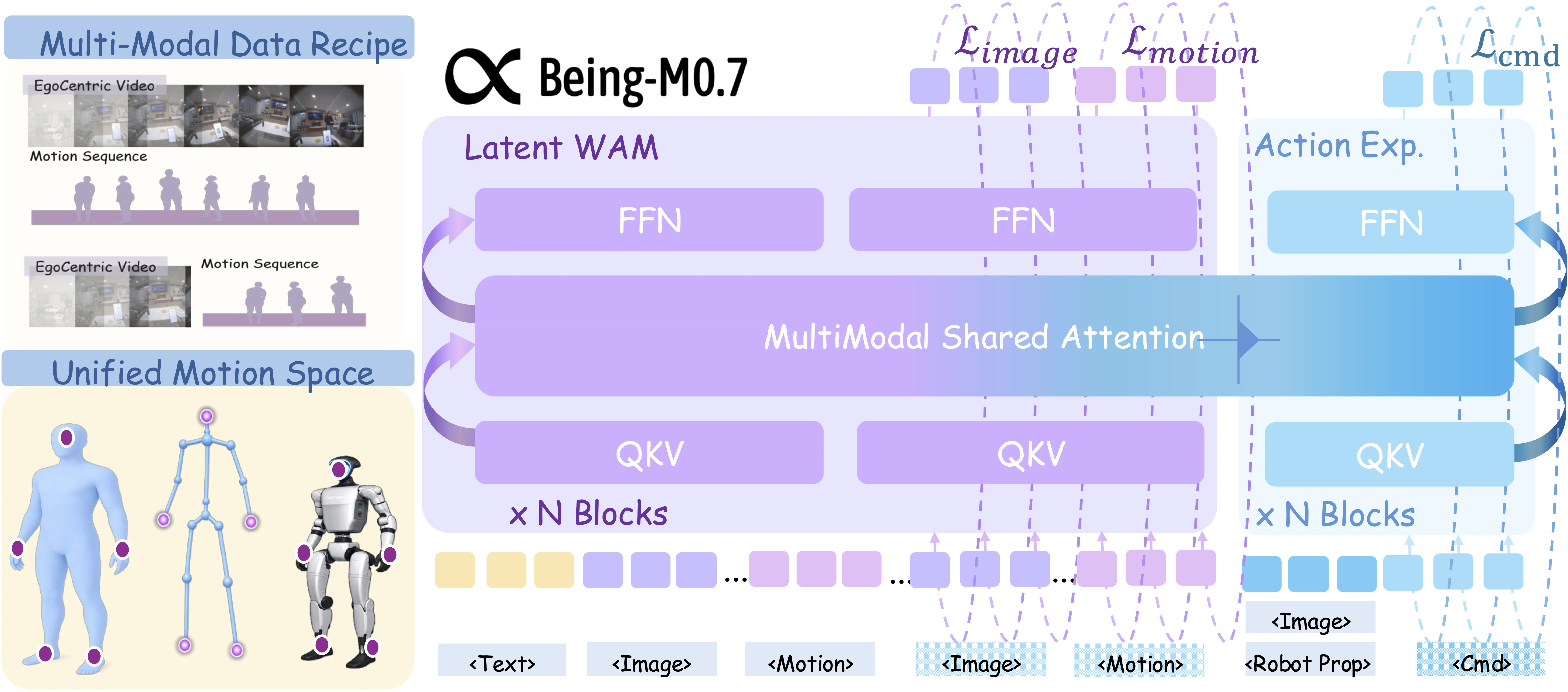
Being-M0.7 is a latent world-action model for humanoid loco-manipulation. It is designed around the observation that scalable humanoid control should not rely only on costly robot demonstrations or reactive action imitation. Instead, the model first learns a human-centric video-motion prior from mixed-modality data, then grounds this prior into embodiment-specific robot commands through post-training. The pretrained prior models future egocentric visual states together with a compact whole-body motion sequence, where motion serves as a coarse action-level plan rather than a directly executable command. A lightweight future-conditioned action expert subsequently combines the predicted future context with current robot observations to produce low-level action chunks. Together, the pretrained latent prior and the post-trained action expert form a complete world-action model: the prior supplies lower-frequency predictions of scene evolution and whole-body intent, while the expert supports higher-frequency, closed-loop command generation.
Pre-training Data
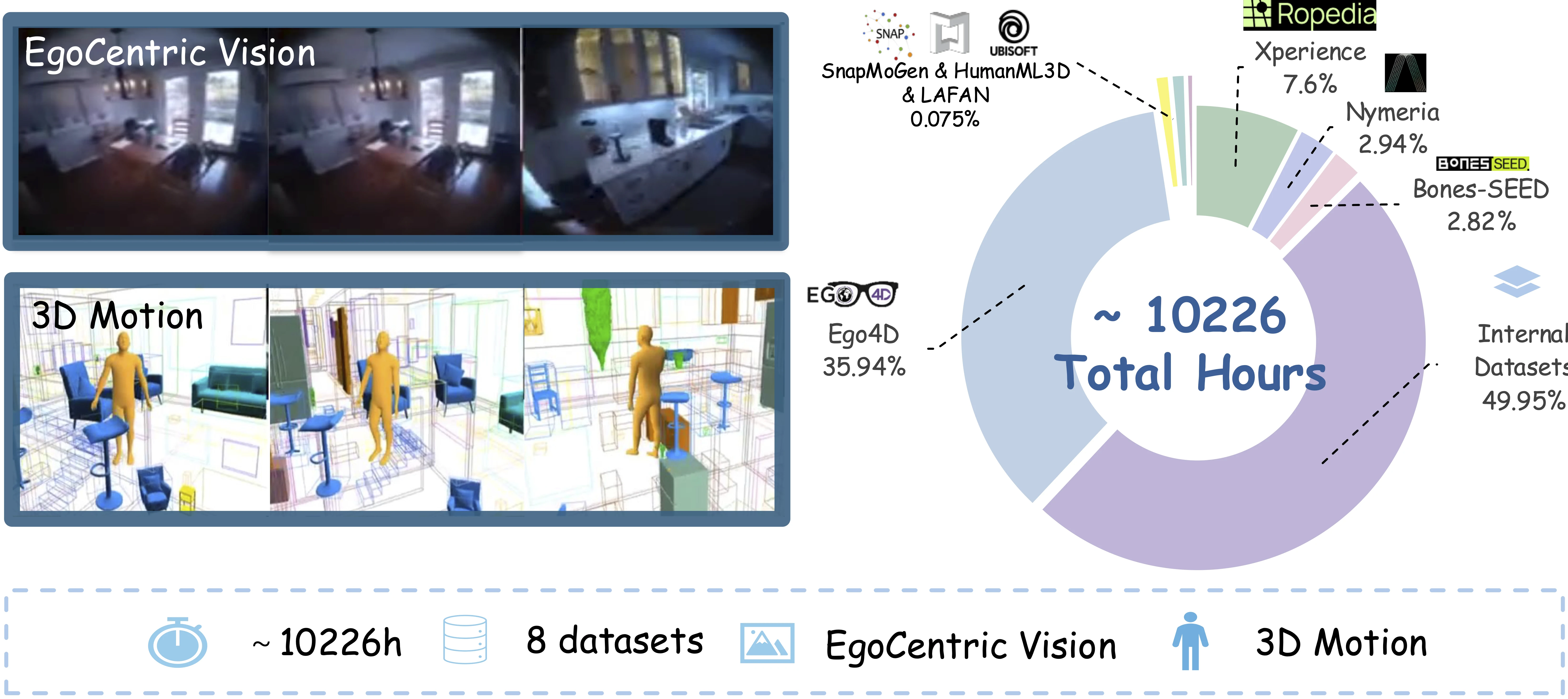
The pre-training corpus is constructed from a raw collection of more than 10,000 hours of human-centric mixed-modality data before filtering and temporal segmentation. It contains three complementary supervision streams: egocentric video-motion pairs, egocentric videos, and human motion sequences. Paired samples provide joint video-motion supervision, while video-only and motion-only samples expand coverage through their respective marginal modalities. This allows the model to benefit from diverse interaction contexts, vision-grounded motion, and broad whole-body kinematic data without requiring all supervision to be collected in expensive robot demonstrations.
Visual inputs are represented with frozen DINO features rather than pixels. The model therefore predicts future image latents, concentrating its capacity on semantic scene state, object layout, and scene evolution instead of low-level image reconstruction. Heterogeneous human motion data are converted into a unified head-root representation and canonicalized to reduce source-specific variation. A compact representation retaining the head, both hands, and both feet provides the main interaction and contact cues while remaining compatible with humanoid robot trajectories. The same interface can be reconstructed from robot kinematics using forward kinematics, which provides additional motion supervision during post-training and an additional motion-feedback path during deployment.
Model Architecture and Training
The pretrained prior is implemented as a video-motion Mixture of Transformers (MoT). Visual latents and motion tokens use modality-specific projections, normalization, and feed-forward computation, while shared attention enables information exchange across modalities and time. Task instructions are encoded separately and provided as language conditioning. Given a short observed context, the model jointly generates future visual latents and future motion tokens with a chunk-based attention pattern: context tokens represent observed history, and noisy future tokens denoise the full target chunk in parallel.
Pre-training uses flow matching. On paired video-motion samples, the model learns the joint distribution of future visual and motion states. Video-only and motion-only samples activate only their available losses, thereby learning the marginal distributions of vision and motion. These marginal objectives constrain the joint model while substantially increasing the usable pre-training data. Motion targets also receive geometry-aware auxiliary supervision for global trajectory consistency and local end-effector dynamics.
Post-training attaches a future-conditioned action expert to the pretrained prior. For each robot trajectory, the prior is still trained to predict future visual and motion states, while the action expert reads one-way intermediate representations from the prior together with the current egocentric observation and proprioceptive state. It outputs a short sequence of executable robot actions. This preserves the video-motion dynamics learned from human data while adapting the model to robot-specific control. During inference, the prior periodically produces a future video-motion plan; its representations can be reused by the action expert across multiple low-latency command updates.
Robot Post-training Data Collection
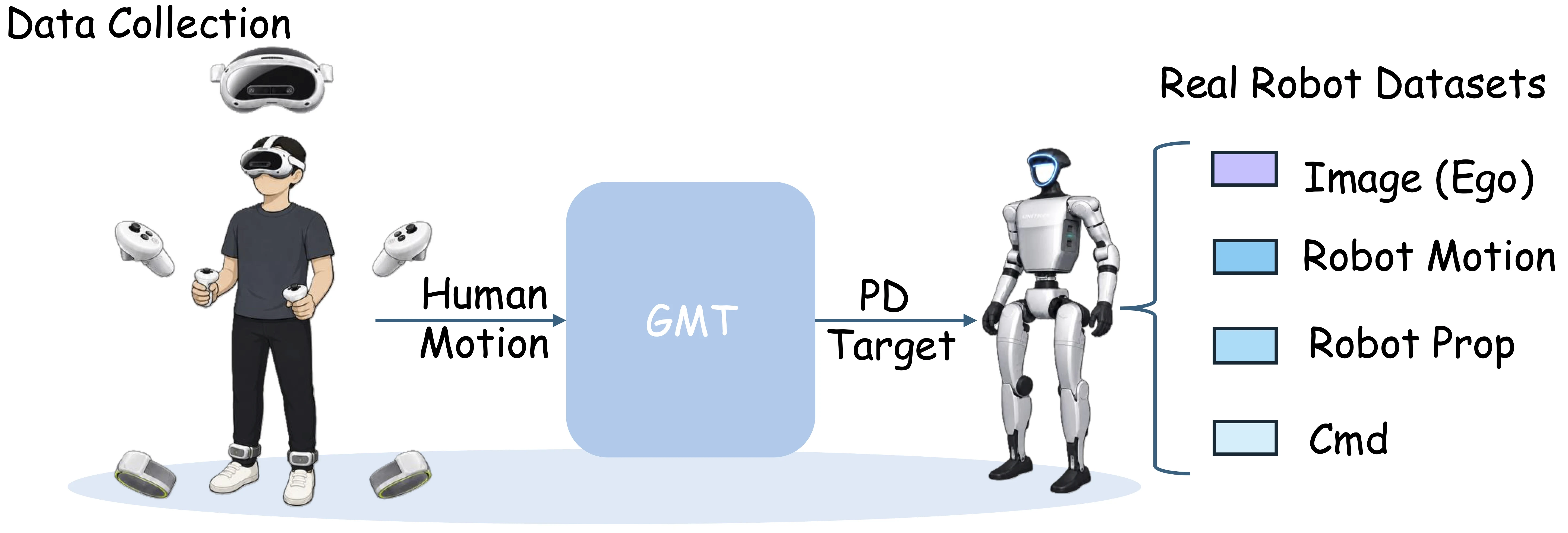
Robot post-training data are collected through a VR-based whole-body teleoperation pipeline on the Unitree G1 humanoid robot. An operator provides full-body motion through a VR headset, handheld controllers, and ankle-mounted trackers. The operator motion is estimated as an SMPL pose and converted into stable whole-body robot commands by a motion-tracking controller running at 50 Hz. The system records synchronized egocentric RGB observations, robot proprioception, executable motion commands, and robot motion representations. These trajectories ground the pretrained human-centric prior into the robot embodiment while retaining supervision for both future state prediction and action generation.
Summary
Being-M0.7 represents our first steps toward latent world-action modeling for humanoid loco-manipulation. The work combines scalable human-centric mixed-modality pre-training with robot-specific post-training: a latent video-motion prior captures future scene and whole-body dynamics, and a future-conditioned action expert converts this information into executable closed-loop humanoid control. The unified motion representation connects human and humanoid robot trajectories, enabling richer supervision during training and additional feedback during inference.
Citation
@misc{beingbeyond2026beingm07,
  title={{Being-M0.7}: A Latent World-Action Model for Humanoid Robots},
  author={Yue, Junpeng and Li, Boyuan and Wang, Yuxuan and Wang, Zepeng and Fu, Yuhui and Xie, Feiyang and Zhang, Yu and Zhang, Jing and Wang, Jiangxing and Lu, Zongqing},
  year={2026},
  howpublished={BeingBeyond Technical Report},
  url={https://research.beingbeyond.com/being-m07/being-m07.pdf}
}